The ring box that is perfect for a jeans-pocket proposal is exactly wrong for a haloed cocktail ring, and neither one suits a his-and-hers wedding set laid side by side. Fit is not really about the box looking nice on a shelf. It is about two measurements on the ring itself — how tall the setting stands and how wide the band is — and about the moment the box is made for. Get those right and the ring sits secure, the lid closes without touching the stone, and the presentation lands. Get them wrong and you have a lid pressing on prongs, a ring rattling in an oversized well, or a box too bulky to hide. This guide walks through how to size and style a ring box by the ring going into it and the occasion it is for.
Start with the ring, not the box
Two dimensions drive every fit decision. The first is setting height — how far the stone and its mount rise above the band — which sets how tall the box’s interior must be. The second is band width, which sets how wide the holding slot needs to be. A good box holds the ring with roughly the lower half of the band seated in the slot, about five millimeters of clearance to each side, and enough headroom that the lining never presses the stone when the lid shuts. As a rule of thumb, leave at least a few millimeters of air between the top of the stone and the inside of the lid. The standard engagement box at 50 by 50 by 45 millimeters — about two inches on a side — handles something like ninety-five percent of rings, which is why it is the default. The exceptions are what this guide is about.
One trap to avoid: quoted box dimensions are usually the exterior, and wall thickness eats into the space that matters. Rigid paperboard walls run around two millimeters, while a solid wood box can be five to eight millimeters thick, so a two-inch wooden box may offer only about an inch and a half of usable interior. Always confirm the interior measurement, not just the outside.
The five box sizes you actually choose between
Most catalogs are variations on five footprints. The petite box, around 40 by 40 by 35 millimeters, suits minimalist stones and thin bands. The slim or pocket box, roughly 50 by 50 by 19 millimeters, trades vertical room for discretion and is built to disappear in a pocket. The standard box at 50 by 50 by 45 millimeters is the all-rounder. The oversized or deep-well box, around 65 by 65 by 55 millimeters, exists for large halos and cocktail rings that need vertical clearance. And the double box, near 75 by 50 by 38 millimeters in a landscape format, holds two rings side by side. The chart below puts their exterior dimensions together so the differences are easy to see.
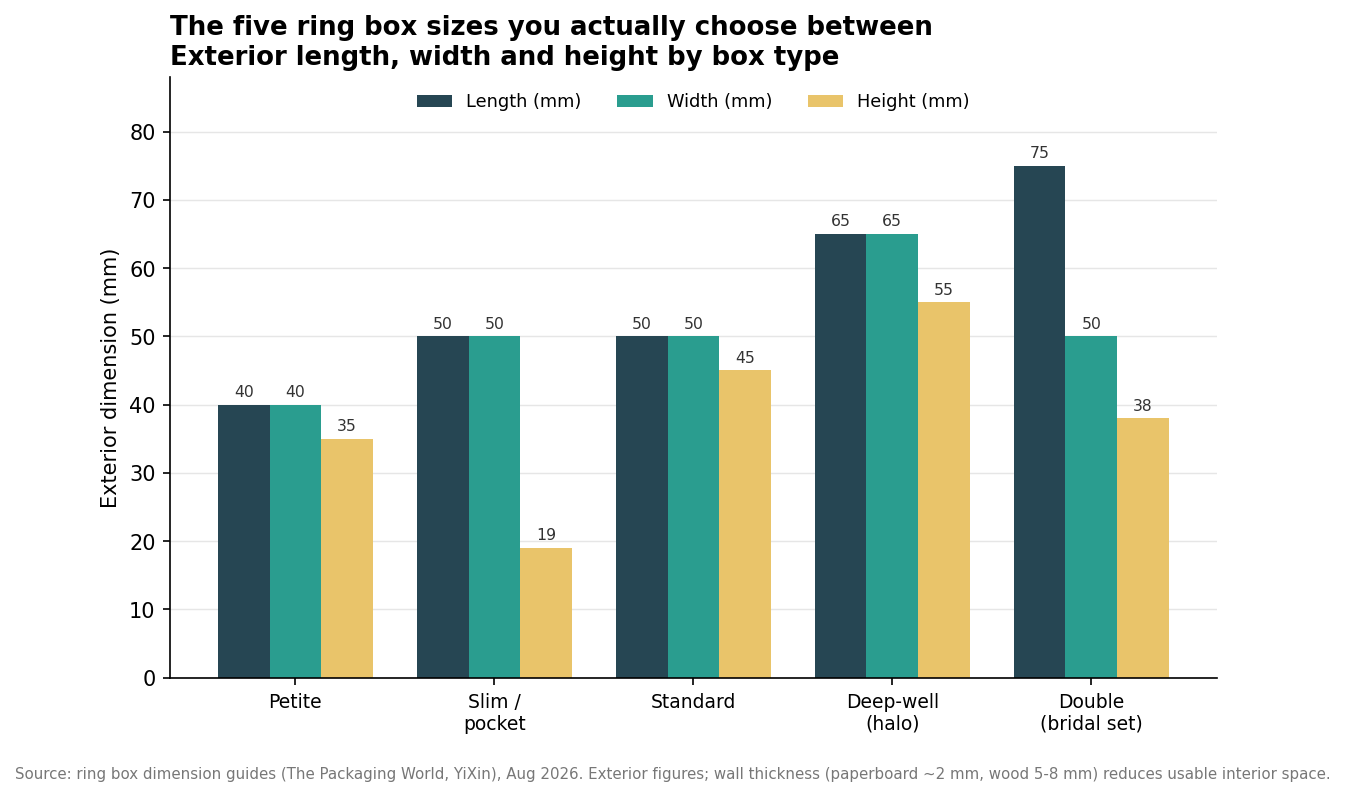
Notice that the slim box is not smaller in footprint than the standard — it is the same 50 millimeters square but barely a third as tall. That is the whole point of it, and also its limitation: it cannot take a tall setting.
Matching box height to the setting
Height is where most fit failures happen. A low-set solitaire is comfortable in a standard 45-millimeter box. A Tiffany-style or medium mount wants a hair more. But cathedral and halo settings, which lift the stone well above the band, need a deep-well box of 55 millimeters or more, and any high-set ring whose mount exceeds roughly 20 millimeters should go into a deep-well or pedestal box so the closing lid never touches the prongs. This is not a cosmetic concern: a lid pressed against a raised stone can distort prongs over time and mark the lining. The chart below maps a sensible minimum box height to each ring type.
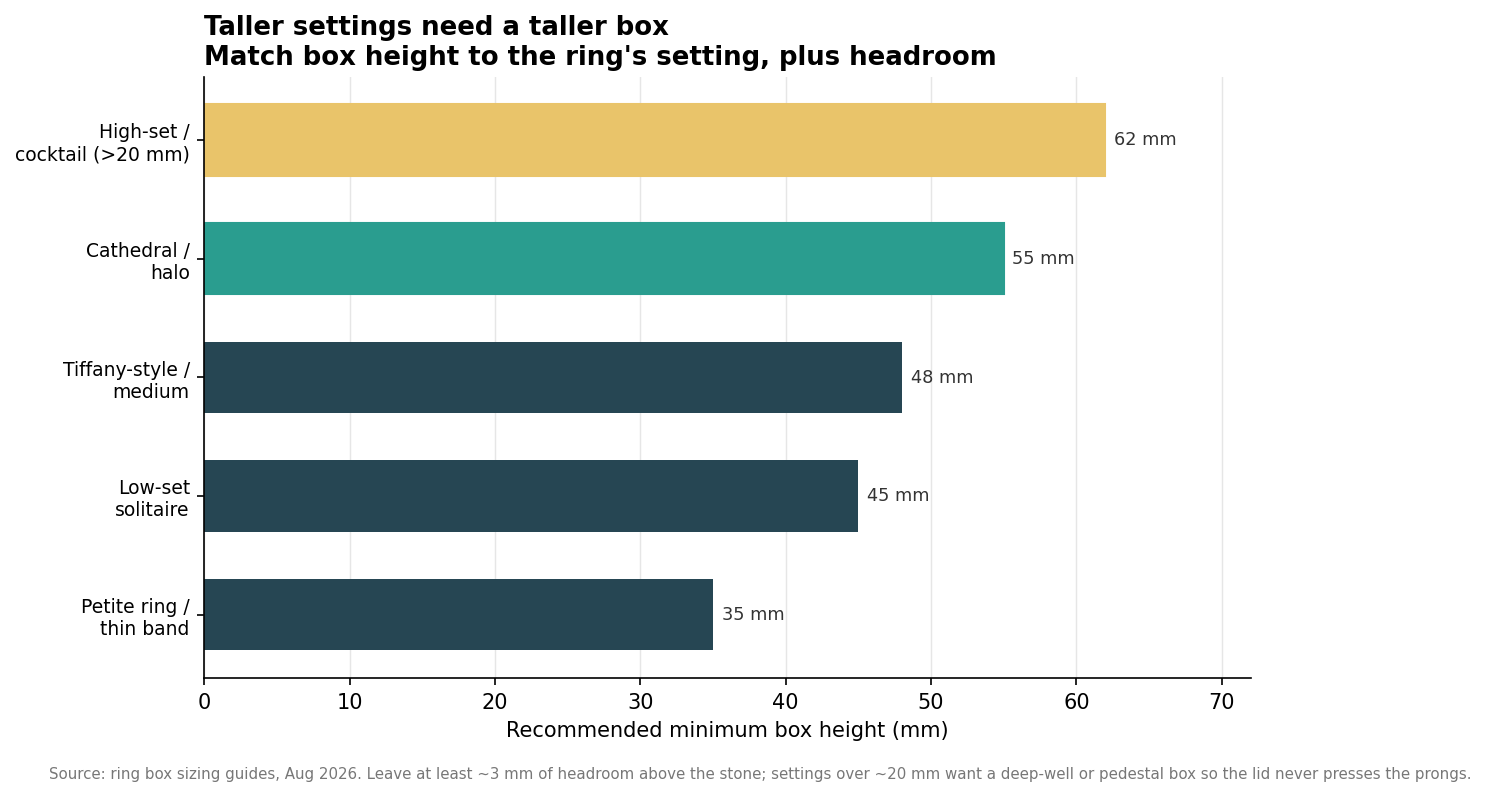
When a customer is between sizes, size up on height. An extra few millimeters of headroom costs nothing in presentation and protects the ring; a box that is a touch too short forces the lid onto the stone every time it closes.
Band width and the slot
The slot has its own limit. A standard slot comfortably holds bands up to about four millimeters, which covers most engagement rings. Wider bands — six millimeters and up, which includes many men’s rings and modern chunky styles — need a wide-slit slot, or the band simply will not seat properly. For a bridal set, the double box’s landscape orientation is built for two rings, and the better versions pair one wide slot with one narrow so a slim engagement band and a broader wedding band each sit correctly instead of forcing both into an identical cut. If you sell men’s bands or stacked sets, confirm the slot width the same way you confirm the height.
Then choose the style for the moment
Once size is settled, style is driven by occasion. For a surprise proposal, the slim flip-top wins because it hides in a pocket. For retail display and everyday gifting, a classic flip-top or domed box shows the ring off with the lid propping open. For presentation and photography — the flat-lay shots that sell online — drawer and book-style boxes create a cleaner frame, and glass-top boxes let the ring show without opening anything. For the wedding day itself, the double box keeps both bands together and scratch-free. And ring-bearer boxes are their own category, usually a slim or double built to survive a walk down the aisle in small hands. Branding follows the style: the inside of a flip-top lid is prime logo real estate, while wood and metal exteriors take engraving well for a personalized keepsake.
A quick fit check before you order
Before committing to a run, measure the tallest ring you intend to sell in that box — setting height first, band width second — then add headroom and side clearance and compare against the interior, not exterior, dimensions. Decide single or double slot based on whether it is one ring or a set, and confirm the slot width against your widest band. Only then choose the style by occasion. Finally, order a single sample and drop your actual ring into it before approving the full order; a box that measures right on paper can still hold a specific ring poorly, and five minutes with a sample is far cheaper than a thousand boxes that pinch the stone.
Leave a Reply