Category: Uncategorized

  • Which Ring Box Fits Which Ring: A Size-and-Style Guide by Occasion

    Which Ring Box Fits Which Ring: A Size-and-Style Guide by Occasion

    The ring box that is perfect for a jeans-pocket proposal is exactly wrong for a haloed cocktail ring, and neither one suits a his-and-hers wedding set laid side by side. Fit is not really about the box looking nice on a shelf. It is about two measurements on the ring itself — how tall the setting stands and how wide the band is — and about the moment the box is made for. Get those right and the ring sits secure, the lid closes without touching the stone, and the presentation lands. Get them wrong and you have a lid pressing on prongs, a ring rattling in an oversized well, or a box too bulky to hide. This guide walks through how to size and style a ring box by the ring going into it and the occasion it is for.

    Start with the ring, not the box

    Two dimensions drive every fit decision. The first is setting height — how far the stone and its mount rise above the band — which sets how tall the box’s interior must be. The second is band width, which sets how wide the holding slot needs to be. A good box holds the ring with roughly the lower half of the band seated in the slot, about five millimeters of clearance to each side, and enough headroom that the lining never presses the stone when the lid shuts. As a rule of thumb, leave at least a few millimeters of air between the top of the stone and the inside of the lid. The standard engagement box at 50 by 50 by 45 millimeters — about two inches on a side — handles something like ninety-five percent of rings, which is why it is the default. The exceptions are what this guide is about.

    One trap to avoid: quoted box dimensions are usually the exterior, and wall thickness eats into the space that matters. Rigid paperboard walls run around two millimeters, while a solid wood box can be five to eight millimeters thick, so a two-inch wooden box may offer only about an inch and a half of usable interior. Always confirm the interior measurement, not just the outside.

    The five box sizes you actually choose between

    Most catalogs are variations on five footprints. The petite box, around 40 by 40 by 35 millimeters, suits minimalist stones and thin bands. The slim or pocket box, roughly 50 by 50 by 19 millimeters, trades vertical room for discretion and is built to disappear in a pocket. The standard box at 50 by 50 by 45 millimeters is the all-rounder. The oversized or deep-well box, around 65 by 65 by 55 millimeters, exists for large halos and cocktail rings that need vertical clearance. And the double box, near 75 by 50 by 38 millimeters in a landscape format, holds two rings side by side. The chart below puts their exterior dimensions together so the differences are easy to see.
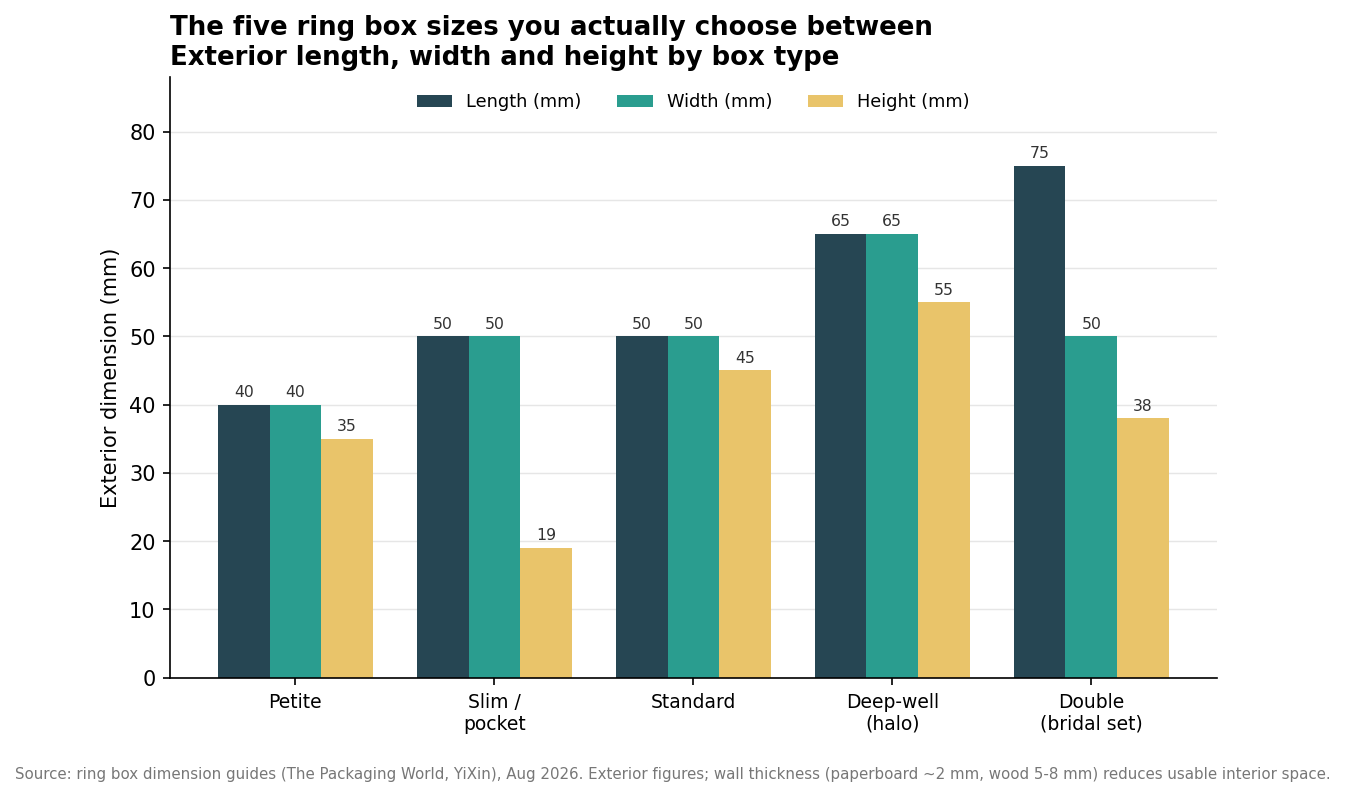
    Grouped bar chart of exterior length, width and height in millimeters for five ring box types: petite, slim pocket, standard, deep-well halo, and double bridal
    The five common ring box footprints by exterior dimension; the slim box shares the standard footprint but is far shorter.

    Notice that the slim box is not smaller in footprint than the standard — it is the same 50 millimeters square but barely a third as tall. That is the whole point of it, and also its limitation: it cannot take a tall setting.

    Matching box height to the setting

    Height is where most fit failures happen. A low-set solitaire is comfortable in a standard 45-millimeter box. A Tiffany-style or medium mount wants a hair more. But cathedral and halo settings, which lift the stone well above the band, need a deep-well box of 55 millimeters or more, and any high-set ring whose mount exceeds roughly 20 millimeters should go into a deep-well or pedestal box so the closing lid never touches the prongs. This is not a cosmetic concern: a lid pressed against a raised stone can distort prongs over time and mark the lining. The chart below maps a sensible minimum box height to each ring type.
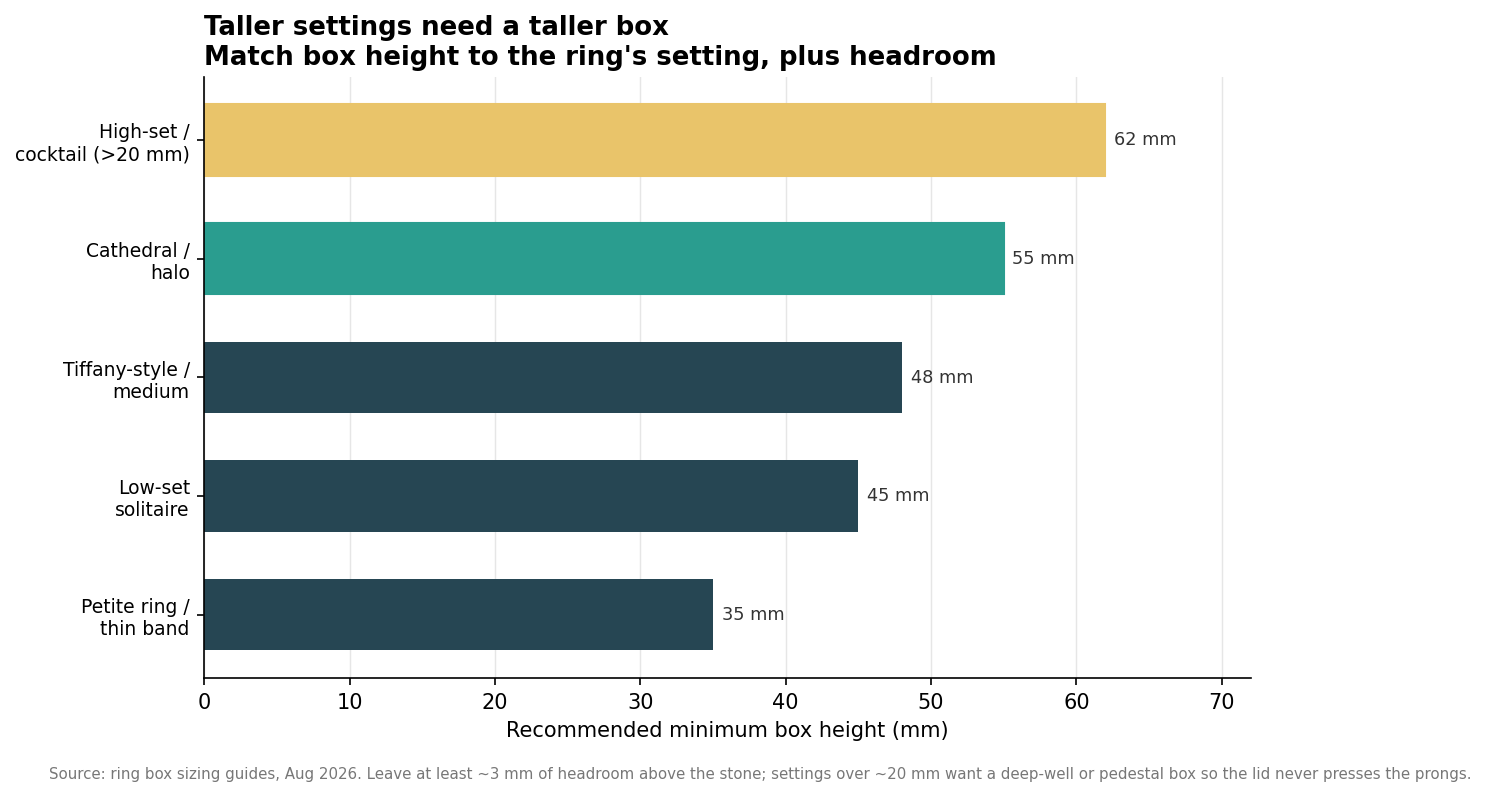
    Horizontal bar chart of recommended minimum ring box height in millimeters by ring type, from petite to high-set cocktail rings
    Recommended minimum box height by ring setting; taller and higher-set stones need a deep-well box.

    When a customer is between sizes, size up on height. An extra few millimeters of headroom costs nothing in presentation and protects the ring; a box that is a touch too short forces the lid onto the stone every time it closes.

    Band width and the slot

    The slot has its own limit. A standard slot comfortably holds bands up to about four millimeters, which covers most engagement rings. Wider bands — six millimeters and up, which includes many men’s rings and modern chunky styles — need a wide-slit slot, or the band simply will not seat properly. For a bridal set, the double box’s landscape orientation is built for two rings, and the better versions pair one wide slot with one narrow so a slim engagement band and a broader wedding band each sit correctly instead of forcing both into an identical cut. If you sell men’s bands or stacked sets, confirm the slot width the same way you confirm the height.

    Then choose the style for the moment

    Once size is settled, style is driven by occasion. For a surprise proposal, the slim flip-top wins because it hides in a pocket. For retail display and everyday gifting, a classic flip-top or domed box shows the ring off with the lid propping open. For presentation and photography — the flat-lay shots that sell online — drawer and book-style boxes create a cleaner frame, and glass-top boxes let the ring show without opening anything. For the wedding day itself, the double box keeps both bands together and scratch-free. And ring-bearer boxes are their own category, usually a slim or double built to survive a walk down the aisle in small hands. Branding follows the style: the inside of a flip-top lid is prime logo real estate, while wood and metal exteriors take engraving well for a personalized keepsake.

    A quick fit check before you order

    Before committing to a run, measure the tallest ring you intend to sell in that box — setting height first, band width second — then add headroom and side clearance and compare against the interior, not exterior, dimensions. Decide single or double slot based on whether it is one ring or a set, and confirm the slot width against your widest band. Only then choose the style by occasion. Finally, order a single sample and drop your actual ring into it before approving the full order; a box that measures right on paper can still hold a specific ring poorly, and five minutes with a sample is far cheaper than a thousand boxes that pinch the stone.
  • Slim Ring Boxes: How to Hide the Proposal Without Outgrowing the Box

    Slim Ring Boxes: How to Hide the Proposal Without Outgrowing the Box

    The most common mistake in a surprise proposal is not the speech or the timing. It is the box. A traditional hinged ring box is roughly a two-inch cube, and that cube prints through a jacket or trouser pocket like a warning sign. Slim ring boxes exist to solve exactly that problem, trading the domed velvet clamshell for a flat profile that disappears in a pocket. They are a genuinely better tool for a secret proposal, but they come with one tradeoff worth understanding before you buy, because a box that is too thin for the ring creates a different problem at the worst possible moment.

    Why the classic box gives you away

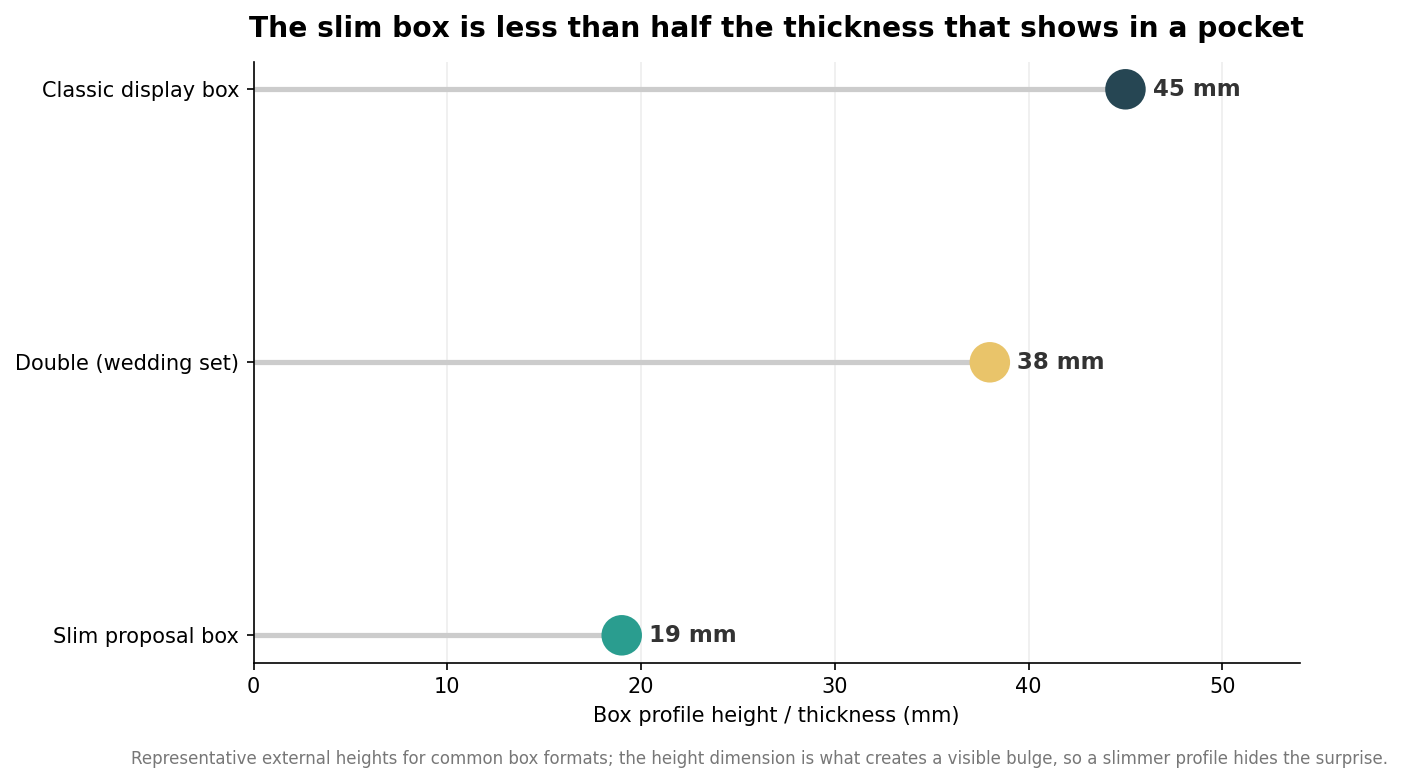
    The dimension that matters for concealment is height, the measurement that stands up off your leg or chest. A classic display box runs around 45 millimeters tall, close to an inch and three quarters, because it is designed to present a ring upright under showroom lights, not to hide. A slim proposal box collapses that same footprint down to something like 19 millimeters, well under half the height, by laying the ring flatter and trimming the lid. That single change is the difference between an obvious bulge and a box that reads as a phone or a wallet through fabric.

    Dot plot comparing the profile height of ring box types: slim proposal box about 19 mm, double wedding-set box about 38 mm, classic display box about 45 mm
    Box height is what shows in a pocket; a slim box is less than half the height of a classic display box.

    Footprint helps too. Slim boxes keep the length and width modest, often near a two-inch square or a slightly longer flat rectangle, so they slide into an inside jacket pocket or even a front trouser pocket without pulling the fabric taut. If total invisibility is the goal, the flat rectangle shapes tend to hide better than squares because they follow the line of a pocket rather than doming out of it.

    The tradeoff nobody mentions: tall stones and slim boxes

    Here is the catch. To get thin, a slim box gives up interior height, and interior height is exactly what a tall setting needs. A good ring box leaves roughly 12 millimeters of air between the top of the stone and the lid so the gem is never crushed or scratched when the box closes, and a box meant to hold an upright solitaire may need to be around 45 millimeters tall internally to do that. A high-set solitaire, a tall cathedral setting, or a big center stone can simply be too tall to sit upright inside a slim box.

    The workaround that slim boxes use is to seat the ring on its side or lay it flatter rather than standing it up, which is fine for many rings and awkward for a few. Before you commit to the slimmest option, measure your actual ring from the base of the band to the top of the stone, add the headroom, and confirm the box’s internal height clears it. A slim box that holds a modest band beautifully can pinch a three-carat cathedral setting, so the ring, not the pocket, should have the final say on how thin you can go.

    Material changes how much room you actually have

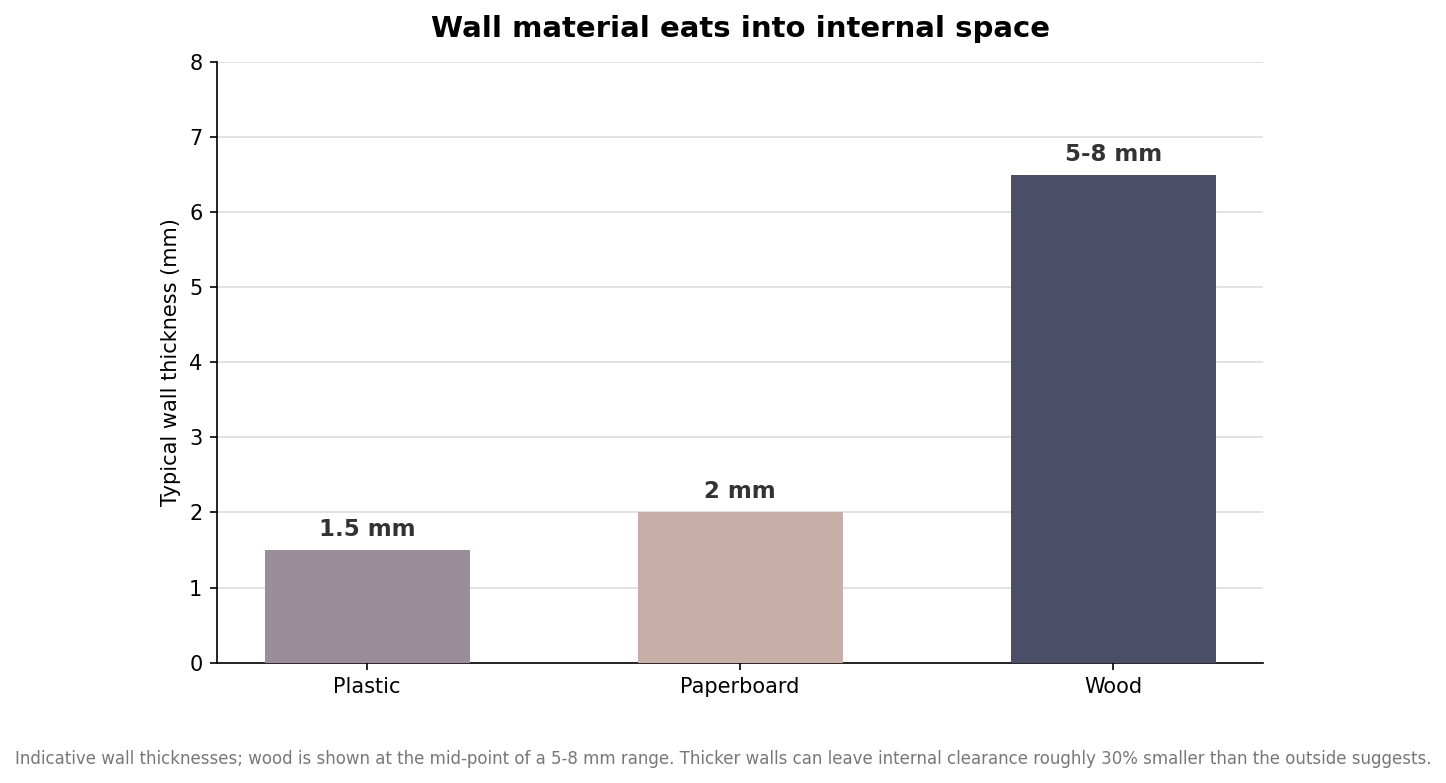
    External dimensions lie a little, because the walls take their cut before the ring ever gets inside. A thin plastic shell might use walls around 1.5 millimeters and a paperboard box around 2 millimeters, while a solid wood box can run 5 to 8 millimeters of wall on every side. That wood feels wonderful in the hand and looks the part on a shelf, but it can shrink the usable internal space by something like a third compared with what the outside measurements suggest.

    Bar chart of typical ring box wall thickness by material: plastic 1.5 mm, paperboard 2 mm, wood 5 to 8 mm
    Thicker wall materials like wood reduce the internal space available for the ring.

    For a slim box specifically, this matters twice over, because you are already working with a tight interior. If you love the warmth of wood but need the box to stay pocketable, expect either a slightly larger exterior to claw back the lost internal room, or a design that accepts a smaller ring. Foam or a fabric-covered insert also consumes a few millimeters, so factor the insert into the clearance rather than measuring to the bare floor of the box.

    Single, double, and the sizes that matter

    Not every ring box is a proposal box. A single-ring format is what you want for the surprise itself, sized tightly around one ring for a clean, secret carry. A double box, commonly a longer rectangle near three inches by two, holds an engagement ring and a wedding band side by side and is meant for the ceremony or for storage afterward, not for hiding in a pocket. If your customer is a jeweler, the retail display box with its taller upright presentation is a third animal entirely, chosen to show the ring off rather than to conceal it. Matching the format to the moment prevents the classic error of buying one box and expecting it to do all three jobs.

    How to choose without ruining the moment

    Work the decision in this order and a slim box almost never disappoints. First, measure the ring’s full height with the stone and add roughly a centimeter of headroom; that number sets the minimum internal height, and it decides whether the ring can stand up or must lie flatter. Second, pick the material with the wall thickness in mind, remembering that a lush wood or thickly padded box eats interior room a bare plastic one does not. Third, choose the footprint for the pocket you will actually carry it in, favoring a flat rectangle for the best concealment. Only after those three are settled should you think about color, monogram, or a printed message inside the lid, because a beautiful box that either bulges or crushes the stone has failed at the one job it was bought for.

    A slim ring box is a small object doing a surprisingly demanding task: vanish completely, then present a ring flawlessly seconds later. Get the internal height right for your specific stone, respect what the wall material takes away, and match the format to the moment, and you end up with a box that keeps the secret right up until the instant you want it to stop keeping it.

  • A Jeweler’s Guide to Ring Box Margins — Custom Ring Boxes

    Call or Text us: (929) 605-4397

    HomeBlog › A Jeweler’s Guide to Ring Box Margins

    Jewelers

    A Jeweler’s Guide to Ring Box Margins

    06/30/2026

    Most independent jewelers price a custom ring box as a straight cost against a plain generic one, see the difference, and stop there. That comparison misses what a branded box actually does: it turns every sale into free marketing, and it raises the perceived value of the ring itself before the box is even opened.

    Here is a simple way to think about the margin math before your next order.

    The real per-unit gap

    A blank generic ring box typically costs a fraction of what a custom foil-stamped or laser-engraved version costs at the same volume — but that premium narrows fast as order size grows. At 500 units, the branding premium often works out to less than one percent of the average ring’s retail price.

    Where the return shows up

    A branded ring box gets photographed, shared on social media, and kept for years after the purchase — a repeated, unpaid impression of your brand that a generic box never earns. It also reinforces the price point of the ring itself: a premium box signals a premium product before a customer even lifts the lid.

    Order sizeTypical per-unit range*
    50$10–$14
    250$7–$10
    1,000$5–$8
    5,000+$4–$6

    *Estimates only, illustrative of typical volume pricing — request a quote for your exact specs.

    Setting your retail price

    A simple rule of thumb: price the box as part of your cost of goods, not as a separate line item, and let the branding justify a small increase in your finished-ring price rather than trying to recover it directly. Over a full production run, the packaging premium is almost always smaller than the perceived-value lift it buys.

    Key takeawayA custom ring box typically adds a small premium per unit at volume, and the branding keeps working as free marketing and perceived-value lift long after the sale.

    Ready to upgrade your packaging? Get a custom quote — free mockups in 24–48 hours. Learn more about how we work, or browse more guides.

    More posts

  • How to Order Custom Ring Boxes: A Step-by-Step Checklist — Custom Ring Boxes

    Call or Text us: (929) 605-4397

    HomeBlog › How to Order Custom Ring Boxes: A Step-by-Step Checklist

    Ordering

    How to Order Custom Ring Boxes: A Step-by-Step Checklist

    06/08/2026

    Ordering custom ring boxes for the first time can feel like it involves more decisions than it actually does. Strip it down to five steps and most first-time buyers — jewelers, planners, and brands alike — can go from idea to a finished quote in a single conversation.

    Here’s the checklist we walk every new customer through.

    1. Pick a style

    Start with your use case: a single-ring solitaire calls for our Classic Velvet or Leatherette box; a matched set calls for the Double-Ring Proposal Box; a staged proposal calls for the Bouquet Holder Set; a keepsake-tier gift calls for Engraved Wood.

    2. Choose a material and color

    Match the material to your brand feel — velvet for traditional and romantic, leatherette for modern and boutique, wood for heirloom weight. Then pick a color from our standard options or request a custom Pantone match.

    3. Decide on decoration

    Foil stamping for a bold, reflective logo or monogram; laser engraving for a permanent, understated mark; deboss (leatherette only) for a colorless textural logo.

    4. Set your quantity and timeline

    Our minimum is 50 units. Estimate what you need for the next quarter or wedding season rather than ordering the bare minimum repeatedly — volume pricing improves meaningfully above a few hundred units. Flag any hard deadline (a launch date, a wedding date) up front so we can confirm rush options if needed.

    StepWhat we need from you
    1. StyleProduct page or use case
    2. Material & colorVelvet / leatherette / wood + color choice
    3. DecorationLogo file or reference image
    4. Quantity & timelineTarget quantity + in-hands date
    5. ApprovalSign-off on mockup

    5. Approve the mockup

    We return a photo-real mockup within 24 to 48 hours of your quote request. Review it, request any free revisions, and once you approve, production starts the same day and ships in two to three weeks.

    Choosing for your order

    Most first orders take less than fifteen minutes to specify once you know your style, material, and rough quantity — the rest of the detail work happens in the mockup stage, at no charge.

    Key takeawayFive decisions — style, material and color, decoration, quantity and timeline, and mockup approval — are all it takes to place a custom ring box order.

    Ready to start your order? Get a custom quote — free mockups in 24–48 hours. Learn more about how we work, or browse more guides.

    More posts

  • Do Custom Ring Boxes Actually Hold Up? A Durability Comparison — Custom Ring Boxes

    Call or Text us: (929) 605-4397

    HomeBlog › Do Custom Ring Boxes Actually Hold Up? A Durability Comparison

    Buyer guides

    Do Custom Ring Boxes Actually Hold Up? A Durability Comparison

    05/17/2026

    A ring box isn’t a one-time-use item the way most packaging is — it gets carried in pockets before a proposal, handled repeatedly in a display case, shipped across the country, and often kept for years afterward as a keepsake. That means durability matters more here than in almost any other custom packaging category.

    We get asked constantly which of our materials actually holds up best, so here’s an honest comparison based on how each performs in the field.

    Hinge and closure durability

    Wood boxes with a magnetic closure show the least wear over time, since there’s no mechanical hinge tension to loosen. Velvet and leatherette boxes use a friction-fit or reinforced hinge that holds up well through normal use but is the first place any lower-quality box will show wear — which is why we spec reinforced hinges as standard across our line.

    Surface and finish wear

    Laser engraving is the most durable decoration method across all three materials — it’s part of the surface itself and cannot flake, fade, or rub off. Foil stamping holds up very well under normal handling but, on lower-quality boxes with poor heat-bonding, can show wear at high-friction contact points like a pocket edge. Our foil is heat-bonded for lasting adhesion.

    MaterialHinge durabilitySurface wear resistanceShipping resilience
    VelvetGoodGoodGood
    LeatheretteVery goodVery goodVery good
    Engraved woodExcellentExcellentGood

    Shipping and transit

    Leatherette’s rigid frame handles the bumps of freight and last-mile shipping best of the three, arriving with the cleanest corners. Velvet performs well but benefits from extra protective packing on long shipments. Wood is heavier and very durable structurally, but its weight adds modestly to shipping cost at scale.

    Choosing for your order

    If your boxes travel a lot — direct-to-consumer shipping, planner travel kits — leatherette is the safest bet. If a box needs to feel like a keepsake and rarely leaves a shelf, engraved wood wins on longevity. Velvet remains an excellent all-around choice for in-store and light-shipping use.

    Key takeawayLaser engraving is the most durable decoration method across all materials; leatherette handles shipping and repeated handling best; engraved wood offers the longest-lasting keepsake feel.

    Ready to choose a durable ring box for your order? Get a custom quote — free mockups in 24–48 hours. Learn more about how we work, or browse more guides.

    More posts

  • Who Buys Custom Ring Boxes (And Why) — Custom Ring Boxes

    Call or Text us: (929) 605-4397

    HomeBlog › Who Buys Custom Ring Boxes (And Why)

    Audience guides

    Who Buys Custom Ring Boxes (And Why)

    04/26/2026

    Custom ring boxes sell to a narrower set of buyers than most packaging categories, but the reasons each buyer orders are surprisingly different. Understanding which segment you fall into helps decide which style, material, and order size actually fits your business.

    Here’s a look at the six buyer types we work with most.

    Jewelers & independent designers

    The largest and most consistent buyer group. They want every sale — online or in-store — to leave with a branded unboxing moment, and typically start with our Classic Velvet Ring Box before adding a premium wood option as their line matures.

    Wedding & proposal planners

    Planners buy in smaller batches ahead of a wedding season and prioritize durability above all — a box has to survive travel, weather, and a nervous hand on the actual day. Many also order our Ring Box Plus Bouquet Holder Set to stage a complete proposal scene.

    Bridal boutiques

    Boutiques buy for in-store use as a finishing touch on every purchase, often favoring Leatherette Ring Boxes that match a more modern in-store aesthetic and hold up to repeated handling in a display case.

    Jewelry subscription brands

    Subscription brands need the same box to arrive the same way every month at real scale, prioritizing consistency and cost efficiency over premium upgrades like engraved wood.

    Corporate gifting & anniversary awards

    Corporate buyers lean toward the Engraved Wood Ring Box for its heirloom weight, ordering in smaller batches tied to specific service-anniversary milestones rather than continuous volume.

    E-commerce jewelry brands

    Online-only brands need packaging that photographs well for social content and survives a shipping box intact — usually landing on Leatherette for its structural rigidity in transit.

    Choosing for your order

    Most buyers start in one segment and expand into a second as their business grows — a jeweler adding a wood option, or a boutique adding personalized sets for weddings. Tell us which segment you’re in and we’ll recommend a starting style and order size.

    Key takeawayEach of the six core buyer segments prioritizes something different — branding, durability, in-store fit, consistency, heirloom weight, or shipping resilience — so the right starting style depends on which one you are.

    Ready to find your fit? Get a custom quote — free mockups in 24–48 hours. Learn more about how we work, or browse more guides.

    More posts

  • Velvet vs. Leatherette: Choosing a Ring Box Material — Custom Ring Boxes

    Call or Text us: (929) 605-4397

    HomeBlog › Velvet vs. Leatherette: Choosing a Ring Box Material

    Buyer guides

    Velvet vs. Leatherette: Choosing a Ring Box Material

    04/05/2026

    Every jeweler and jewelry brand eventually asks the same question when they move past a generic supplier box: velvet or leatherette? Both materials wrap the same velvet-wrapped MDF or PU-leather shell construction, but they send different signals about a brand, and they perform differently over time.

    Here’s how the two compare across the factors that actually matter for a bulk order.

    Look and feel

    Velvet has a soft, low-nap texture that reads as traditional and romantic — the classic jewelry-case look most consumers associate with an engagement ring. Leatherette has a firmer, smoother surface that reads as more modern and boutique, closer to a premium accessory brand than a heritage jeweler.

    Durability

    Leatherette’s rigid internal frame holds its shape better under repeated handling and resists corner-crushing in a display case. Velvet is more prone to showing wear at the seams over months of daily handling, though it remains fully serviceable for the life of a typical retail or gifting cycle.

    FactorVelvetLeatherette
    FeelSoft, traditionalFirm, modern
    DurabilityGoodVery good
    Decoration optionsFoil, engraveFoil, engrave, deboss
    Typical unit cost$4–$10$5–$11

    Decoration compatibility

    Both materials take foil stamping and laser engraving cleanly. Leatherette adds a third option — a blind deboss with no color at all — which velvet’s nap texture can’t hold as crisply.

    Choosing for your order

    Choose velvet if your brand leans traditional, bridal, or heirloom, and if softness and classic feel matter more than structural rigidity. Choose leatherette if your brand leans modern or boutique, if boxes need to survive shipping direct-to-consumer, or if you want a deboss option alongside foil and engraving.

    Key takeawayVelvet suits a traditional, romantic brand feel; leatherette suits a firmer, more modern presentation and travels better. Both take foil stamping and laser engraving equally well.

    Ready to choose a material for your ring boxes? Get a custom quote — free mockups in 24–48 hours. Learn more about how we work, or browse more guides.

    More posts

  • Personalizing a Ring Box for the Proposal Moment — Custom Ring Boxes

    Call or Text us: (929) 605-4397

    HomeBlog › Personalizing a Ring Box for the Proposal Moment

    Weddings

    Personalizing a Ring Box for the Proposal Moment

    03/15/2026

    A proposal happens once, but the box that held the ring can last for decades — tucked in a drawer, displayed on a shelf, or handed down as a keepsake. The single detail that turns a ring box from packaging into a memento is personalization: an initial, a date, or a short phrase that ties the box to that exact moment.

    Here’s how jewelers, planners, and couples typically approach it.

    What to personalize

    The most common options are a monogram of both partners’ initials, the proposal date in a simple numeral format, or a short phrase like “will you” or “forever starts here.” Keep it short: a ring box lid has limited real estate, and a crowded design reads worse in photos than a clean, single line of text.

    Choosing a decoration method for personalization

    Foil stamping renders crisp lettering in gold, silver, or rose gold and photographs with a bright metallic highlight — ideal for a bold monogram. Laser engraving instead creates a permanent, matte impression that reads more subtly in person but never fades, making it the better choice for a date or phrase meant to last a lifetime without any risk of the finish wearing off.

    Personalization typeBest decoration methodTypical placement
    Couple’s monogramFoil stampCenter of lid
    Proposal dateLaser engravingBelow monogram or on interior
    Short phraseLaser engravingInterior lid or box base

    Timing the order

    Because personalized boxes still go through our standard mockup-and-approval process, order at least three to four weeks ahead of a planned proposal date to leave room for a revision round and standard production time. Rush production is available for last-minute plans, but locking the design early gives the best result.

    Choosing for your order

    Whether you’re a jeweler offering personalization as an upsell, a planner building it into a proposal package, or a couple ordering directly, the goal is the same: a design simple enough to read at a glance, in a finish that will still look right in twenty years.

    Key takeawayKeep personalized ring box designs short and simple, use foil stamping for a bold monogram and laser engraving for a lasting date or phrase, and order at least three to four weeks ahead of the proposal date.

    Ready to personalize a ring box? Get a custom quote — free mockups in 24–48 hours. Learn more about how we work, or browse more guides.

    More posts